| |
Many things in life are difficult to accomplish.
However, the most demanding task is to continuously engage
one's mind in the divine form of God. Through enlightening
analogies, Shriji Maharaj explains how this can be achieved.
|
Devotees of all faiths undertake countless
endeavours to attain spiritual perfection and oneness with God. Mostly,
they take the form of physical commitments in which they subject their
body to intense austerities and other activity-based feats. Many have
gone on record as having fasted, remaining without or on a severely
restricted ration of food or water, for days and months at a time. Others
have undertaken arduous pilgrimages travelling in novel ways such as,
performing prostrations, rolling (gabad yatra) or moving on all fours,
etc. Their efforts are to be praised and used to inspire others. Despite
the strenuousness of these feats, are they the most difficult things
to do on the spiritual path? Few would disagree that to stretch one's
body to its physical limits is indeed very, very difficult. But is there
anything which may be more difficult to do? In Vachanamrut Gadhada I-1,
Shriji Maharaj asks, "Which is the most difficult of all spiritual
endeavours?" Providing the answer, He reveals, "There is no
spiritual endeavour more difficult than to continuously engage one's
mind on the form of God."
This surely is an insight which will be readily acknowledged by everyone.
Controlling and directing the tangible body is less demanding than focussing
the intangible mind on the divine form of God. It may be the most difficult
but certainly not impossible. By the use of vivid analogies throughout
the Vachanamrut, Shriji Maharaj describes in many ways, the understanding and practices one has to develop to attain
this undivided focus on the divine form of God.
many ways, the understanding and practices one has to develop to attain
this undivided focus on the divine form of God.
Drop by Drop
In Vachanamrut Gadhada I-23, Shriji Maharaj describes, "Consider,
for example, a pot that is filled with water and emptied somewhere.
If another pot of water is subsequently emptied at the same place on
the following day or the day after that, a pool of water will not collect
there. Why? Because the water poured on the first day dries up on that
very  day,
and the water poured on the second day also dries up on that same day.
On the other hand, if a trickle of water were to flow continuously,
a large pool of water would soon be formed. Therefore, while eating,
drinking, walking, engaging in any activity whatsoever - whether it
be pure or impure - in fact, at all times, one should constantly keep
one's vrutti on God. While maintaining one's vrutti constantly on God
in this manner, one attains that abiding elevated spiritual state."
Thus, undivided concentration on the form of God results from a continual
effort during every activity to remember Him. day,
and the water poured on the second day also dries up on that same day.
On the other hand, if a trickle of water were to flow continuously,
a large pool of water would soon be formed. Therefore, while eating,
drinking, walking, engaging in any activity whatsoever - whether it
be pure or impure - in fact, at all times, one should constantly keep
one's vrutti on God. While maintaining one's vrutti constantly on God
in this manner, one attains that abiding elevated spiritual state."
Thus, undivided concentration on the form of God results from a continual
effort during every activity to remember Him.
Combining one's
Energies
In Vachanamrut Gadhada I-25, Shriji Maharaj says, "If twenty pails
of water are drawn from a well, and the flow of water from each pail
allowed to flow in separate directions, then there would be little force
in each flow. However, if the flow of all twenty pails of water are
combined, then the resultant flow would become extremely powerful -
like that o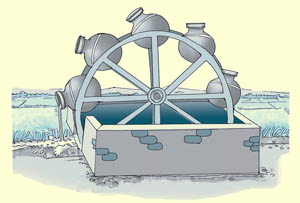 f
a river - and would not be able to be diverted by any means whatsoever.
Similarly, when a person's vruttis have become free of worldly desires,
his chitt focuses only on God's form." We all interact with the
physical world through our five senses. We acquire maximum information
when all our senses are focussed on one task. Similarly, all our senses
must be focussed on the divine form of God to achieve the highest benefit. f
a river - and would not be able to be diverted by any means whatsoever.
Similarly, when a person's vruttis have become free of worldly desires,
his chitt focuses only on God's form." We all interact with the
physical world through our five senses. We acquire maximum information
when all our senses are focussed on one task. Similarly, all our senses
must be focussed on the divine form of God to achieve the highest benefit.
Resting Place
Through His question in Vachanamrut Gadhada I-32, Shriji Maharaj reveals,
"Birds leave their nests to gather food, but after gathering their
food, they always return to their respective nests at night to rest.
Never do they forget their own nests and return to another bird's nest.
Similarly, after feeding on discourses, talks, devotional songs, etc.,
related to God, devotees of God also return to their own nest in the
form of God to rest. Again, animals, birds and, in fact, all creatures,
return to their respective homes to rest after feeding. People also
travel far and wide for their work, but only when they return to their
own home do they rest peacefully. "Now based on the analogies that
I have just narrated, I ask all the devotees: Just as a non-believer
is attached to worldly vishays and is unable to live without them for
even a single moment, similarly, after becoming firmly attached to the
vishays in the form of shravan, manan, etc., of the talks and discourses
related to God, have you also become attached to and engrossed in them,
or not? Also, just as a bird returns to its nest after feeding, do all
of you also return to rest in your nest, the form of God, after feeding
on feed in the form of discourses, devotional songs, etc., related to
God? Or, do you rest elsewhere? Furthermore, cattle that are domesticated
return to their stake in the evening after grazing in the village outskirts,
whereas stray cattle do not return to their stake. A stray cow, after
grazing in someone's field, sits wherever it wishes. There, someone
may beat it, or if a tiger comes, it may even attack the cow. Now, do
you return to your stake like the domesticated cattle, or like the stray
cattle, do you sit down to rest anywhere after grazing in someone else's
field?" From this, one has to understand that although we may be
engaged in worldly duties, ultimately, one has to resort to the murti
of God to find real and lasting peace.
Written
by: Sadhu Amrutvijaydas
|
|