Unique Vision
of Yogiji Maharaj
Samp, Suhdrudbhav and Ekta were three of many fundamental principles
that Yogiji Maharaj had repeatedly preached during his ministry.
He emphasised this central theme as a vital link with God. Without
it one would fail to perceive and experience the joy and divinity
of Satsang. |
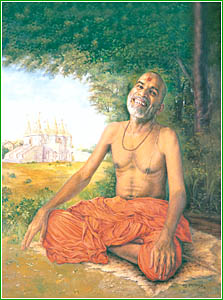 Brahmaswarup
Yogiji Maharaj laid stress on several aspects during his ministry
to promote common weal and amity in Satsang. On countless occasions
he had inspired to imbibe samp, suhradbhav and ekta in life. This
quality could also be called fraternity feeling. In fact, they formed
the cornerstone of his philosophy. Be it a small group or a public
address, a gathering of devotees or youths, he never tired in repeating
these words and exhorting his audience to cultivate these noble qualities.
Time and place was not important to him. It could be past midnight
or 4 am, the gathering could be a handful of people or a vast concourse
of humanity come to listen to his words of wisdom. What was important
to him was that the message had to be put across for the good of Satsang.
During his final three years, Yogiji Maharaj repeated these words
more and more. If we were to imbibe his words then we would experience
peace, happiness and the living joy of Akshardham.
Brahmaswarup
Yogiji Maharaj laid stress on several aspects during his ministry
to promote common weal and amity in Satsang. On countless occasions
he had inspired to imbibe samp, suhradbhav and ekta in life. This
quality could also be called fraternity feeling. In fact, they formed
the cornerstone of his philosophy. Be it a small group or a public
address, a gathering of devotees or youths, he never tired in repeating
these words and exhorting his audience to cultivate these noble qualities.
Time and place was not important to him. It could be past midnight
or 4 am, the gathering could be a handful of people or a vast concourse
of humanity come to listen to his words of wisdom. What was important
to him was that the message had to be put across for the good of Satsang.
During his final three years, Yogiji Maharaj repeated these words
more and more. If we were to imbibe his words then we would experience
peace, happiness and the living joy of Akshardham.
Gunatitanand Swami emphasised on four things as the soul of life -
command or order (agna), mode of true worship (upasana), love for
an ekantik sadhu (priti) and amity (suhradbhav). Of these four, affection
(priti) appears to be the best. It seems clear that through love for
the ekantik sadhu, agna, upasana and suhradbhav are nourished. But
Yogi Bapa used to say that suhradbhav is the best. If one has suhradbhav
then one develops love for the ekantik sadhu and becomes firm in upasana
and agna.
Once Yogiji Maharaj asked the devotees of Mumbai, "If we were
to 'paint' Mumbai with the colour of Satsang, what should be done?"
There were old-timers and veteran devotees like Vajubhai in the gathering.
But none of them could answer. Swamiji himself supplied the answer.
"If we were to 'paint' Mumbai with the colour of Satsang we should
have unity and friendship (samp, suhradbhav and ekta)." Everyone
was amazed as to how one could possibly 'paint' Mumbai with Satsang?
If we have these noble qualities ourselves then we are bound to leave
our impression on others. Then Yogiji Maharaj explained that there
was no escape from unity and amity. He also said, "If we don't
have these qualities then Shriji Maharaj will punish us." In
fact Shriji Maharaj never punishes any of his devotees. Then what
does this mean? It means we will not have admittance to Akshardham
and will have to repeat the cycle of births and deaths.
Often Yogiji Maharaj would talk about the need for mutual respect.
In Satsang one has to understand each others greatness. If one has
samp, suhradbhav and ekta then naturally there will be a lot of peace
and progress in Satsang. Another facet of suhrudbhav is that one should
not expose anothers faults. It is but natural every individual is
not made the same way. There are bound to be differences in habits,
speech, conduct, etc. And we normally discuss and gossip on such things.
But this does not bring peace and joy to anyone. We should not expose
and publicise faults through such futile talks. Many problems crop
up in our families. We hear of sons and daughters running away from
home without their parent's knowledge. But we do not publicise such
things. Why? Because they are ours we do not want the world to know
that such a thing has happened. Similarly, the Satsang is an extension
of our family. So whatever holds for our family also applies to devotees
of Satsang. He likened Satsang to a garden laid out by Shriji Maharaj.
All the sadhus and devotees are like a big family. Pramukh Swami and
Shriji Maharaj are the mother and father of this united family. Unless
we convince ourselves that there cannot be any happiness without all-round
unity we cannot have the experience of bliss in Satsang. Though this
means appear simple, but it is not. This endeavour does not include
the telling of beads, observing fasts and performing prostrations
or circumbulations. It is a tough mental exercise. If this wonderful
aspect of Satsang is clearly grasped then it can be implemented in
life. That was the earnest desire of Yogi Bapa.
With reference to unity in Satsang, Gunatitanand Swami has said, "If
all sadhus, palas and Brahmacharis maintained unity then no matter
how great the inner enemy be, he would never be able to get the better
of you. If this was not the case, even minor defects would overwhelm
one and throw one out of Satsang."
Disunity invites Adharma. Whenever such a phase begins no one, not
even the greatest of gods, men or munis could be saved and there would
not be any happiness. This was the awareness that Yogiji Maharaj used
to give often. Gunatitanand Swami has brought out the dangers of disunity
through a revealing story. "There was a king. He called the front-ranking,
valiant soldier of his army to break a quiverful of arrows. As all
the arrows were tied together the brave soldier could do nothing.
The king then untied the bundle and called a timid soldier not known
for any exploits to break a single arrow. This he could achieve easily
because only one arrow had to be broken. Thus if all of us stand united
then Maya or bad times cannot harm us." Unity is the watchword
that no power on earth could touch. Such unity is possible only where
there is love and affection among the members of the Satsang-fold.
Otherwise it is not possible. If we cannot understand the glory of
Satsang then we will regress and fall from Satsang. In Vachanamrut
Gadhada I. 28. Shriji Maharaj says that when a devotee is likely to
regress in Satsang he begins to perceive faults in all devotees. And
he feels the devotees lack understanding and that only he understands.
He feels that only he is intelligent and knows everything. And in
this frame of feelings he smoulders like a half-burnt log.
Swami says if one has samp, suhradbhav and ekta then one will not
find faults in others.
Once Yogiji Maharaj went to Vadtal on the banks of the Gomti. There
Shriji Maharaj had performed a lot of leelas. There is a mango tree
by the lake. Yogiji Maharaj said, "This mango tree never tells
beads, performs puja or darshan of Thakorji. Yet, if the devotees
are told to offer it a litre of milk every day then everybody would
oblige. But if he is asked to give a cup of milk to a particular devotee
then he will not do so. Instead he will complain, how can we when
he is like this and like that." They would conduct a minute observation
of his defects and shortcomings. This shows our nature. Because of
our tendency for fault-finding we do not derive any happiness from
Satsang. That is why Jaga Swami highlighted that it was none of our
business to look at anothers shape, actions and qualities. We should
see only the good points of those in Satsang. Only then will we progress
in Satsang.
Yogi Bapa often narrated the story of Ratnakar and the four brothers
while emphasising the need for unity in Satsang. The four brothers
who were known for their unity decided to please the Sea-god in order
to earn riches from him. When the first brother sat on the seashore
to pray and meditate another would go to the bazaar to look after
purchases. The third brother would attend to cooking and the fourth
would fill water from a well. As there was complete unity and suhradbhav
among them nobody could set them against one another. In this way
the brothers were awaiting the day when the Sea-god would appear before
them and make them rich by rewarding them with the treasure.
The Sea-god was happy with the way the brothers were going about their
task of appeasing him. He decided to confer the riches on them but
first he wanted to test them to see whether they were really united
or was it a mere make-belief to get the treasure. The god appeared
in the guise of a man before the brother whose business it was to
cook and said: "My dear fellow you are so hard working. You cook
food and because of the smoke your eyes have become red. Look at your
other brothers, they seem to be enjoying themselves and speak disrespectfully
of you. They seem to be doing nothing compared to your exertions."
The cook did not like to hear anything adverse about his other brothers.
So the god in human form had to beat a hasty retreat when the brother
became angry. Next the god went to the brother who was filling water.
His luck did not hold there either and he had to quit the place. After
he was convinced that the brothers stood solidly by one another and
were united, he appeared before them in his divine form and gave the
gold and precious stones.
Yogiji Maharaj explained that if somebody came carrying tales or speaking
ill of others one's curiosity and interest would peak. Therefore if
anyone brings such talks don't lend your ear. If you do so then the
person will empty such ill talks before you. Suhrudbhav means giving
one's bedding to another and sleeping on the floor and giving one's
plate to another and remaining hungry. Yogi Bapa treated all devotees
with the same affection and spoke of their glory - a trait which Pramukh
Swami too shares with him.
Yogiji Maharaj used to say that the smallest of the small devotee
was his crown. It is difficult for anyone to even think of this but
it was in the heart of Yogiji Maharaj. He used to say that a devotee
however small should be placed on one's head. Yogiji Maharaj would
often touch the feet of even the junior most sadhu if the latter had
performed some extraordinary service during a festival. So suhrudbhav
is believing the smallest of devotees as one's crown.
And he also preached that suhrudbhav means not seeing anothers fault.
Note that one pays no attention to the faults of a true friend. Even
in his manner of speaking, talking and eating one sees no faults because
of the bond of love and friendship. Despite his faults one would highlight
his virtue - this is suhradbhav.
In 1971 Yogiji Maharaj made his last trip to Nairobi (East Africa).
He laid stress as usual on the importance of suhradbhav among the
devotees. Once Swamiji was sitting in an assembly. The assembly was
to start at 6 pm. Because of Swamiji's bad health there was a ban
on his visiting devotees' houses. Even then a devotee of standing,
approached Yogi Bapa with a request to visit his house. To please
the veteran devotee Swamiji went to his home. But the visit took longer
than originally thought of. The assembly had started and the devotees
were waiting for Swamishri's arrival. Yogi Bapa came at 7 pm. Many
people were disappointed at the long absence of Swamiji as they had
come to listen to his blessings. They were very angry with the devotee
who had taken Yogiji Maharaj. One senior and spiritually knowledgeable
devotee could not control himself and told Yogiji Maharaj in public,
"Bapa! you should not have done this? You have come very late.
All the devotees were waiting for you. They have missed your spiritual
presence all this while." Swamiji replied to the query in a cool
manner. "I have not been keeping good health and had been asked
by the doctor not to visit Kenya. I came because you had all started
penance, telling the rosary and other means as a request to come.
So I have come to please you all. My earnest desire is that you should
all have friendly feelings towards one another and should maintain
samp, suhradbhav and ekta." The devotee regretted what he had
said and realised the true goal in Satsang.
When Shastriji Maharaj was trying to spread the knowledge of Akshar-Brahman,
there were many who did not like it. Even though he was the target
of criticism, he never allowed anybody to talk ill of the rival faction
who were trying to oppose him. Shastriji Maharaj suffered a great
deal of persecution because of his definite views on Akshar. His followers
were equally harassed. Despite all these difficulties he never permitted
anybody to create ill will towards his detractors.
The Sanstha has progressed due to the feelings of mahima (glory) and
divinity that have been fostered by Shastriji Maharaj, Yogiji Maharaj
and Pramukh Swami Maharaj. They have never nourished ill will for
those who have opposed them. Yogi Bapa said that if one has suhradbhav
then one will understand the glory of others and be blessed with such
glory and humility in one's soul. Suhradbhav is a link to God. Gunatitanand
Swami has asked what is the best of all good things? It is the association
with God and the holy Sadhu. And what is the worst of all things?
It is manushyabhav for both God and His holy Sadhu. When you are face
to face with Pramukh Swami Maharaj and if you have manushyabhav, then
there is no link between him and you.
Yogiji Maharaj's discourses on manushyabhav and suhradbhav cannot
be found in scriptures. It is distilled from his saintly existence
and given out to others. He says that ekta (unity) is having paksha
(taking sides) for one another. It also means perceiving divinity
and taking another's fault or blame upon oneself. If you see any defects
in others, don't gloat over them but take it on your head. That was
the lesson he taught to the Satsang.
Once a saint overturned a vessel containing ghee. Nirgundas Swami
was very annoyed. But Yogiji Maharaj said, "I had overturned
the ghee." Nirgun Swami knew that Yogi Bapa had nothing to do
with the loss of ghee and yet he took it upon himself. This could
be possible only because he saw Shriji Maharaj in everyone. Whereas,
we see the person, his actions and faults. And that is why we can
never cultivate the feeling of unity. Today, Pramukh Swami Maharaj
is spreading this principle of samp, suhrudbhav and ekta. He is endeavouring
day and night and the source of power behind his untiring effort is
his vision of divinity and glory for all. A human being cannot do
this. Only one who has communion with God can endeavour in such a
manner. He inspires love for God and provides the warmth of God to
countless. If we cultivate the qualities of unity and friendly feelings
in our lives we will be able to derive the fullest benefit and happiness
of Satsang.
Translation
of a discourse by Sadhu Ishwarcharandas