|
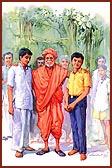
Youths and children were very dear to Yogiji Maharaj. He often said, “Youths are my heart.” And he cared for them as one cares for one’s heart. He spoke to them affectionately, showed genuine interest in whatever they said, and lovingly put his hands on their heads or shoulders in appreciation. Moving his delicate hands around their neck he would quietly check whether the youth had a kanthi or not. If any one was found without a kanthi, he would immediately give him one. He won them over by showering them with more love than even a mother.
In the summer and Diwali vacations, Yogiji Maharaj used to take the youths to the villages with him. During this time he would teach them Swamini Vatu, Vachanamrut, kirtans, cheshta, etc.
Once, while Yogiji Maharaj was walking with the support of two youths, he said, “On two sides are two youths. In the middle is Yogi the youth.”
He took personal care of the youths who toured the villages with him. He personally prepared rotlas for them, served them food, and in case anyone fell ill, he would care for him during the illness.
Yogiji Maharaj woke up early at 4.30 am and would then awaken the youths. He gave discourses on subjects like agna, upasana and seva. He was especially pleased by those who observed a complete fast with either food or even a drop of water. He showed his joy by blessing them and patting them on their backs. At 11.00 pm, after the evening satsang assembly for the devotees and singing of the cheshta were over, Yogiji Maharaj would gather all the youths in a quiet corner of the hall and sit with them again. He encouraged them to converse among themselves in difference languages such as English, Hindi or Gujarati. He would sometimes join in to amuse the youths by using English words, even though he did not know much English.
Yogiji Maharaj captivated the hearts of even college students. He helped many to overcome bad habits such as smoking, eating pan and visiting the cinema. He inspired them to live a pure, simple and disciplined life, and thus prepared them to become ideal devotees and citizens. Thus, during their vacation every year, the youths accompanied Yogiji Maharaj for a month or two. When they left at the end, he advised them, “Observe niyams sincerely. Attend the weekly youth assemblies regularly. If there isn’t a youth centre in your village, then start one. I will write to you.”
His affection for them was so great that he would take the trouble of walking upto the mandir gate to see them off. The youths were inspired by Yogiji Maharaj and their eyes filled with tears when they left.
|








)




